- This event has passed.
In Conversation with Nicolas Kendall
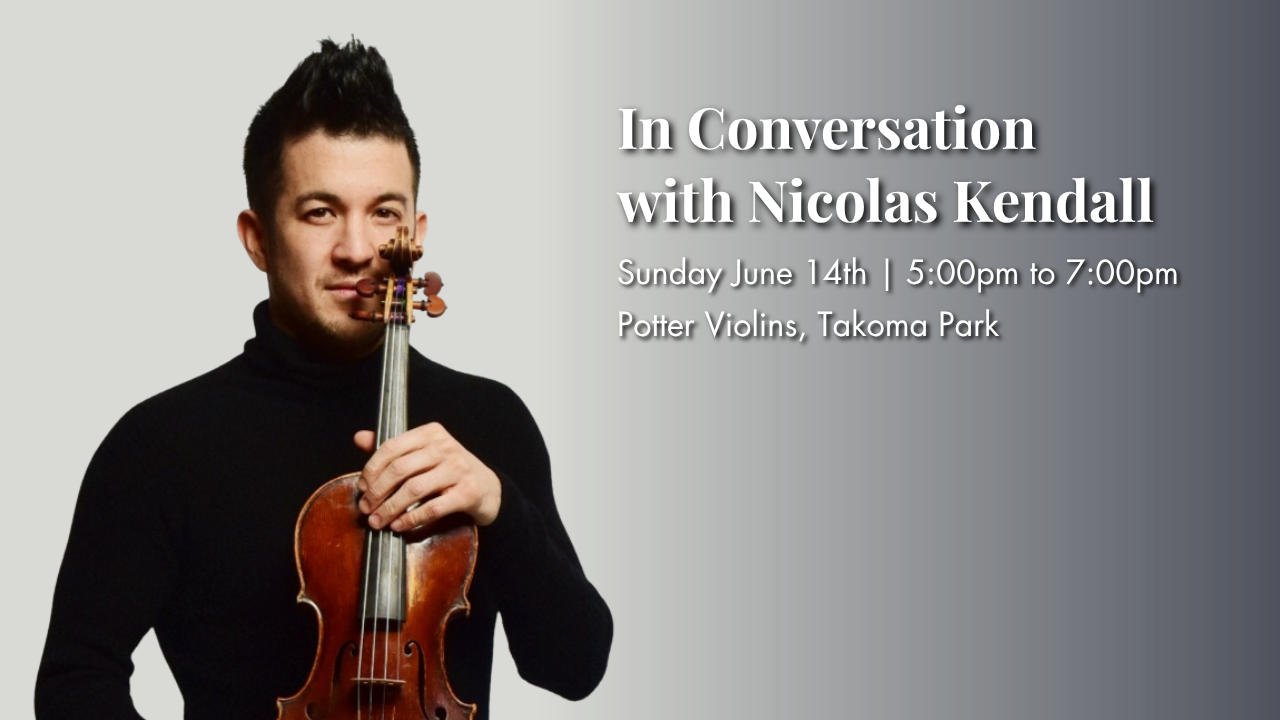
Join Potter Violins’ founder Dalton Potter for a conversation with Nick about his artistic life and the roots it grew from.
On June 14, Potter Violins welcomes Grammy and Emmy Award-winning violinist Nicolas Kendall to a stage that carries his family’s name. Our Kendall Concert Hall honors his grandfather, John Kendall, the pedagogue who introduced the Suzuki method to the United States in the 1960s. Nick grew up in the DC area, participated in the DC Youth Orchestra, and went on to perform at Carnegie Hall, the Sydney Opera House, and BBC Proms as a founding member of the genre-defying string band Time for Three.
Just as important to Nick as the concert stage is the classroom. A self-described communicator and caretaker of his craft, he has brought his children’s concert “Listen up: Music is a Language!” to the Kennedy Center, the Indianapolis Symphony, and the Philadelphia Orchestra, carrying his grandfather’s teaching legacy into a new generation.
Join Potter Violins’ founder Dalton Potter for a conversation with Nick about his artistic life and the roots it grew from. All proceeds from ticket sales benefit the DC Youth Orchestra Program.
About Nicolas Kendall
Nick Kendall is a founding member of the internationally acclaimed string band Time for Three, co-founder of the East Coast Chamber Orchestra, and Artist in Residence at Lincoln Center. His credits include a Grammy-winning recording with the Philadelphia Orchestra, a film score premiered at Sundance, a collaboration with R&B star Summer Walker, and a Christmas Day appearance on ABC’s Good Morning America. He plays an 1838 G.F. Pressenda violin on loan from the Marks family.
About the Potter Violins 30th Anniversary Lecture Series
This year marks 30 years of Potter Violins serving the Washington DC area string community. To celebrate, we launched the Potter Violins Lecture Series, bringing world-class musicians, makers, and educators into conversation with our community. Each event is designed to deepen our collective appreciation for the violin, the people who play it, and the traditions that carry it forward.